
 Kellie Roberts
 Want a lemon drizzle loaf cake that looks special on Mother’s Day but still slices cleanly and stays moist? The reliable answer is a balanced batter, a metal loaf pan, and syrup added while the cake is warm. This version uses simple weights, a 900g loaf tin, and a sharp lemon glaze instead of heavy decoration.
What makes a lemon drizzle loaf cake stay moist?
The cake needs fat, sugar, and controlled moisture
A good lemon loaf is not simply a plain sponge with lemon juice added. It needs enough fat to soften the crumb, enough sugar to hold moisture, and enough flour to give the cake structure. Use 200g unsalted butter, 200g caster sugar, three large eggs, 200g plain flour, 8g baking powder, 100g full-fat Greek yogurt, the finely grated zest of two lemons, and a pinch of salt.
The yogurt matters because it adds moisture without making the batter watery. Lemon juice belongs mainly in the drizzle. Too much juice in the batter can weaken the structure and leave a dense strip through the middle. Bring the butter, eggs, and yogurt close to room temperature before mixing. Cold ingredients can make the batter split, which leads to an uneven rise.
Why the warm drizzle works
The drizzle does more than add sweetness. It moves through small holes in the warm cake and carries lemon oil into the crumb. Mix 60ml fresh lemon juice with 100g granulated sugar. Pour it over the loaf 10 minutes after it leaves the oven, when the cake has firmed but remains warm enough to absorb the syrup.
Use a skewer to make holes about 2cm apart. Do not flood the surface in one place. Spoon the syrup across the entire loaf in two passes. The result should be moist, bright, and sliceable rather than wet at the bottom. For Mother’s Day, this method is more dependable than adding extra lemon juice to the batter.
How should you balance lemon, sugar, and flour?
Use zest for fragrance and juice for acidity
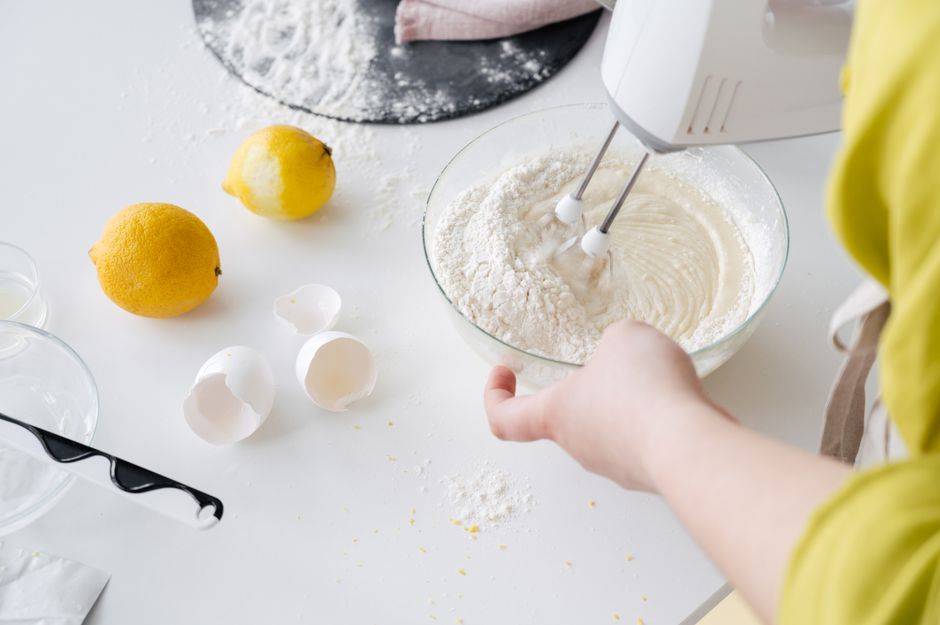
Lemon zest gives the cake its strongest lemon aroma because the peel contains the fruit’s fragrant oils. Rub the zest into the caster sugar with your fingertips before adding the butter. This releases the oils and spreads them through the batter. Juice adds acidity and freshness, but it can also add too much liquid if you pour in more than the recipe needs.
For a loaf using 200g flour, the zest of two medium lemons gives a clear lemon flavor without turning bitter. Add 60ml juice to the syrup and reserve two tablespoons for the glaze. If your lemons are unusually large and produce more juice, do not automatically add it all. Extra liquid can make the middle gummy.
The correct batter should drop slowly from a spoon
Cream the butter and sugar for three minutes, then add the eggs one at a time. Scrape the bowl after each addition. Fold in the flour, baking powder, salt, and yogurt just until no dry streaks remain. The batter should look thick and smooth. When lifted with a spoon, it should fall in a slow ribbon rather than run like pancake batter.
If the mixture curdles slightly after the eggs, add one tablespoon of the measured flour and keep mixing briefly. Do not beat the batter hard once the flour goes in. Overmixing develops gluten and produces a chewy, peaked loaf. The best crumb comes from stopping as soon as the dry ingredients disappear.
How do you bake the loaf evenly from edge to centre?
Follow this exact baking sequence
- Heat the oven to 170°C conventional or 160°C fan. Let it heat for at least 20 minutes.
- Grease a 900g loaf tin and line the base and long sides with baking paper, leaving a little paper above the rim.
- Spoon in the batter and level the centre with a small spatula. Make a shallow line along the top if you want a neat split.
- Bake on the middle shelf for 50 to 60 minutes. Avoid opening the oven during the first 40 minutes.
- Test the centre with a skewer. It should come out with a few moist crumbs, not liquid batter.
- Leave the loaf in the tin for 10 minutes, then pierce and drizzle it while warm.
Use visual and temperature checks together
Ovens vary, so the clock is only one guide. A finished loaf should have a golden top, a firm centre, and edges that pull slightly from the tin. If you use a digital probe, aim for roughly 96°C to 99°C in the centre. A lower reading usually means the middle needs more time, even if the top looks done.
If the top browns before the centre sets, cover it loosely with foil after 35 minutes. Do not press the foil onto the batter. A sudden temperature drop can cause a rising cake to sink, so keep the oven door closed and check only when the loaf is close to its expected baking time.
Why do lemon drizzle loaf cakes fail?
Why does the middle sink?
A sunken centre usually means the cake structure set too late. The batter may contain too much liquid, the oven may have been opened early, or the loaf may have been removed before the centre reached a safe temperature. Do not add extra lemon juice because you want a stronger flavor. Put the extra lemon into the drizzle or glaze instead.
A deep crack is not a failure. Loaf cakes often split along the top as the centre rises. A collapsed, wet trench is different. It signals underbaking or an overloaded batter. Check the tin size too. A narrow, deep tin makes the centre take longer than a broad 900g loaf tin.
Why is the cake dry or greasy?
Dry cake usually comes from too much flour, too little fat, or a long bake. Weigh 200g flour instead of scooping it directly from the bag. If the loaf is greasy, the butter may have been too warm or the batter may have split badly after the eggs went in. Scrape the bowl and mix in one spoonful of flour if the mixture starts to separate.
Why does the drizzle sit on top?
The syrup will not travel through a cold or tightly packed loaf. Add it after 10 minutes, make holes across the full surface, and pour slowly. Holes that are too shallow trap the syrup near the crust. Holes that are too large can create wet tunnels, so use a thin skewer rather than a wooden spoon handle.
How should you adapt the cake for Mother’s Day?
Keep the loaf simple and make the finish deliberate
My recommendation is a plain glazed loaf with thin lemon slices, not heavy decoration. The cake already has a strong shape and a bright colour. Mix 150g icing sugar with two tablespoons of lemon juice for a thick glaze. Wait until the loaf is completely cool before spooning it over the top. If the cake is warm, the glaze will melt into the crumb and disappear.
For a clean finish, place the loaf on a wire rack over a sheet of baking paper. Spoon the glaze down the centre and let it run naturally toward the sides. Add a little finely grated lemon zest while the glaze is still wet. Candied lemon peel can look elegant, but it adds extra work and may make the slices harder to cut.
Choose the right substitutions
- For a softer crumb, replace the Greek yogurt with 100g sour cream.
- For a dairy-free version, use a plant-based block made for baking and unsweetened plant yogurt.
- For a sharper lemon taste, add one extra teaspoon of zest to the sugar rather than extra juice to the batter.
- For a less sweet cake, keep the full syrup but reduce the glaze to 100g icing sugar.
- For a nut-free table, check the labels on plant-based butter and flour blends because some are made in shared facilities.
Do not replace all the flour with ground almonds if you want the same loaf structure. Almonds add fat and weight, so the baking time and liquid balance change. For a dependable Mother’s Day centrepiece, keep the core recipe intact and change only the finish.